Saturday, September 22, 2012

The 3rd Fontana Book of Great Ghost Stories


After a slight dip in quality in the second volume, the Fontana Book of Great Ghost Stories is back with a “Boo”!  Even Robert Aickman’s introduction has more zest.  Aickman writes that “As an antidote to daily living in a compulsorily egalitarian society, a good ghost story… can bring real joy.”  He attempts to define a good ghost story as one that opens a door and leaves it ajar at the end of the story, perhaps referring to his own open-ended tales.

E.F. Benson, celibate son of an Archbishop of Canterbury, leads off the collection with Negotium Perambulans, in which a similarly celibate narrator returns to the idyllic Cornish town of his youth to encounter an ambiguous creature which, though not very pleasant itself, preys on the wicked.  Benson wrote many excellent supernatural stories, and this is among them.
 
“There he lay a-dying,” said the last of my informants, “and him that had been a great burly man was withered to a bag o’ skin, for the critter had drained all the blood from him.  His last breath was a scream…”
 
The End of the Flight, by Somerset Maugham, involves a man pursued around Malaysia by another bent on revenge.  Supernatural elements are hardly even suggested, but the story does leave the door ajar at the end. 

The next 71 pages are deservedly taken up by Oliver Onions’ The Beckoning Fair One.  It is one of the best ghost stories.  Aickman says it best in his introduction:  “An almost perfect story, its perfection is the more impressive by reason of the unusual but indispensable length to which it is sustained.”

The Dream, by A.J. Alan, is a simple story, but it’s told in such a straightforward, avuncular way that it is impossible to dislike.  Alan’s conversational style served him well, as he broadcast his stories on the BBC from 1924-1940.  My guess is that this one may also have begun as a radio broadcast. 

I didn’t care for The Stranger, by Hugh MacDiarmid (known more for his poetry).  It’s the tale of a possibly-unearthly stranger in a pub, which like Alan’s story preceding it could be summed up in a few sentences.  Here, however, MacDiarmid doesn’t create the atmosphere needed for such simplicity to work.

The Case of Mr. Lucraft, by Sir Walter Besant and James Rice, who wrote together from 1871-1882, is highly enjoyable.  I appreciate the fact that in these Fontana anthologies Aickman selected some completely unique premises, and this is one of them.  The unfortunate Mr. Lucraft, narrating from advanced years, takes us through his early life when he bargained away his appetite to the sinister Mr. Grumbelow:

“You will dip the pen,” said the old gentleman, “in the blood.  It is a mere form.  A mere form, because we have no ink handy.”

Another unique story is The Seventh Man, by Sir Arthur Quiller-Couch, which could have been a prototype for Arctic (and Antarctic) horror to come:      

“There, before him, on the frozen coat of snow, was a footprint... many footprints.  Prints of a naked human foot: right foot, left foot, both naked, and blood in each print – a little smear.” 

No Ships Pass, by Lady Eleanor Smith, is one of the few in this anthology I’ve read before.  Maybe this is why it seemed on a second reading a bit too lengthy for what it is; enjoyable, though, as a castaway washes up onto an island and finds himself in a tropical version of No Exit.  

The Man Who Came Back, by William Gerhardi, might have benefitted from a less descriptive title, but is a nicely written example of a concise and traditional ghost story.

Aickman finishes the collection with The Visiting Star, in which an ageless actress comes to perform in a dull mining town in the middle of winter.  I greatly enjoy Aickman, and hadn’t come across this story before.  As is often the case with his works, The Visiting Star is understated, somewhat rambling, and leaves much open to interpretation.  

So, Aickman has selected a wide range of atmospheric supernatural stories here; some are frequently anthologized, some rarely seen, but almost all are highly entertaining. 

Sunday, September 2, 2012

"Isopod" is coming... maybe not to a theater near you.


After filming in 2010 in Georgetown, South Carolina, and dropping off the radar for quite some time, Barry Levinson's "ecological horror" film "Isopod" (or "The Bay", whichever it is) is finally being released on November 2nd, following showings at the Toronto International Film Festival and the New York Film Festival.  However, the film, which doubtless had its genesis when a screenwriter read a news story about parasitic marine isopods, is now being distributed by Roadside Attractions, not Lionsgate, and is expected to see a limited release.

I like the picture Fangoria posted.  It looks like another typical day at Georgetown Hospital. 


Saturday, March 31, 2012

Robert W. Chambers, The King in Yellow, and H.P. Lovecraft


If Robert William Chambers is known at all, he’s known to Lovecraft aficionados. 

Chambers, born in 1865 to a wealthy Brooklyn family, set out to be a painter, studying in Paris from 1886 to 1893.  He soon turned to writing; his first novel, a romance set in the Latin Quarter of Paris, was published in 1894.  However, the 1895 collection The King in Yellow contained the weird stories that Lovecraft enjoyed.

Many of the stories in The King in Yellow involve, sometimes in a minor way, a mysterious play of the same name; those who read it are driven mad by “words in which the essence of purest poison lurk(s).”  The play is linked to the Yellow Sign, “a curious symbol or letter... It was neither Arabic nor Chinese, nor… did it belong to any human script”.  In reference to the play, Chambers uses names from several stories in Ambrose Bierce’s 1893 collection Can Such Things Be?  While there are some fairly mundane stories in The King in Yellow, the supernatural ones are written with delicacy and pervaded by a gloomy melancholy; doomed love, suicide, and insanity are common themes.  They are all told in the first person, usually by a young and sensitive artist.
       
“The Yellow Sign” involves a resurrected corpse, a repetitive question ("Have you found the Yellow Sign?"), and doomed love.  

“The Repairer of Reputations” lacks a supernatural element, but contains a paranoid narrator and the title character, Mr. Wilde, who has savage battles with his cat:

“Howling and foaming, they rolled over and over on the floor, scratching and clawing, until the cat screamed and fled under the cabinet, and Mr. Wilde turned over on his back, his limbs contracting and curling up like the legs of a dying spider. He was eccentric.”

Other noteworthy stories in the collection include the delicate love triangle of “The Mask”, the grim “In the Court of the Dragon”, and the sad prose poem “The Street of the Four Winds”.

Eventually, Chambers became a popular author, publishing over 70 historical and romantic novels before his 1933 death.  By all accounts, they haven’t stood the test of time, and the only one I’ve read (Who Goes There!, 1915), certainly hasn’t.  He revisited supernatural themes only a few times.

Still, Chambers’ early works impressed Lovecraft. In “Supernatural Horror in Literature” (1927), Lovecraft praises Chambers: “The King in Yellow really achieves notable heights of cosmic fear in spite of uneven interest and a somewhat trivial and affected cultivation of the Gallic studio atmosphere…”  Chambers’ influence is most apparent in “The Whisperer in Darkness” (1931), which includes direct references to things Carcosan.  Then there are the Deep Ones.  Chambers wrote a series of humorous, or purportedly humorous, stories about a Bronx zookeeper and his cryptozoological expeditions.  In one of the stories, “The Harbor-Master”, the zookeeper comes across a sinister gilled humanoid lurking in New England waters.  It also seems likely that Lovecraft’s penchant for vague supernatural name-dropping and forbidden books that drive men mad may owe a debt to Chambers.    

So, although Chambers made his living off his popular novels, his early weird tales, imaginative, melancholy, and idiosyncratic, are all that he’s remembered for.   

Monday, November 28, 2011

Horror Express (1972): “Part ape, part man, it lived two million years ago!”


Horror Express is one of those sad orphan films of the public domain, just a little more recent than most.  I watched it via archive.org, which I’ve previously mentioned.

Manchuria, 1906:  A scientific expedition led by Professor Saxton (Christopher Lee in an excellent fur hat and mustache) discovers a frozen/fossilized corpse in a cave, perhaps a missing link.  Returning to Shanghai, Saxton comes across fellow researcher and rival Dr. Wells (Peter Cushing), and they book compartments on the Trans-Siberian Railway.  Even before the train leaves, the death of a thief who tries to get at Saxton’s specimen (now residing in a large crate), and the mutterings of a deranged Russian priest (Alberto de Mendoza) suggest the corpse isn’t as dead as it seems.

Soon, as the dark-eyed priest continues to make dire pronouncements, the corpse, a mummy-like creature with straggly hair, escapes the crate and sneaks around the train, leaving a trail of white-eyed, bloody-faced corpses.  “This brain has been drained,” says Dr. Wells, conducting an skull-sawing autopsy on one of the victims.

It transpires that the creature uses its glowing red eye to suck the consciousness out of its victims, and eventually it is tracked down and shot.  The passengers grow complacent, but the evil isn’t finished with them.  An ancient alien parasite, it seemingly cannot be stopped. To demonstrate just how old the thing is, there’s a very silly scene where Lee and Cushing use a microscope to view unconvincing prehistoric images stored in the creature’s eyeball.

I would have guessed Horror Express was a Hammer production, but it was actually Spanish, shot in Spain (Spanish title: Pánico en el Transiberiano) and directed by Eugenio Martin.  Lee and Cushing work well together as always, and some of the supporting cast, particularly de Mendoza, are also good.  Telly Savalas hams it up in the last third of the film as the Cossack Captain Kazan.  Despite the low budget, the settings are agreeably exotic.  The train speeds through snowy Siberian forests while dastardly doings occur in the claustrophobic, rattling compartments.  The soundtrack is pleasantly eerie, with fuzzy guitars and haunting whistles. 

The somewhat atypical setting and plot, along with the presence of Lee and Cushing, put Horror Express a small step above mediocrity.    

Saturday, November 12, 2011

Them: Best of the Giant Bug Movies


A shell-shocked little girl wandering through the New Mexico desert.  A mangled, deserted travel trailer.  An eerie piping from the desert wastes (“must have been the wind… it’s pretty freakish in these parts”).  A devastated general store in the midst of a sandstorm, the electric light bobbing wildly in the wind.  So begins the classic 1950s monster movie Them!, one of the best of the genre and certainly the best of the giant insect sub-genre.

The film starts out slow and sinister, as grizzled police Sergeant Peterson (James Whitmore) and fresh-faced FBI agent Robert Graham (James Arness) try to solve a string of disappearances and murders.  The lonely desert, with tumbleweeds, blowing sand, and howling wind, is used to great effect.  Soon, the doctors Medford, a father and daughter team of myrmecologists from the Department of Agriculture join the team, having identified a mysterious footprint as that of an oversized ant.  As the senior Dr. Medford, the great character actor Edmund Gwenn (who was in his late seventies when the movie was shot) injects a great deal of energy and humor to the film.  As his daughter, Joan Weldon gives a rather bland performance, perhaps aided by the fact that no romance really develops – it’s all about the ants.  Still, most of the acting is quite decent.     

The special effects, using enormous ant puppets, are surprisingly effective, and the first appearance of a giant ant, looming monstrously over a sand dune, is thrilling.  Much of the film is action-packed, with an arsenal of machine guns, flamethrowers, bazookas, and grenade launchers being deployed to combat the red (ant) menace.  Soldiers descend into creepy, dark ant nests in scenes reminiscent of the Alien films.  The pacing slows a little too much in the middle, but picks up again as the ants begin to spread across the country.  The finale is tense, claustrophobic, and, naturally, chock full of ants.      

It turns out the ants have mutated as a result of radiation from the first atomic bomb test.  As Dr. Medford gravely states, “When man entered the atomic age, he opened the door into a new world.”  Nuclear-age warning, communist allegory, or simply a good science fiction horror story, Them! is a must see.

Saturday, September 10, 2011

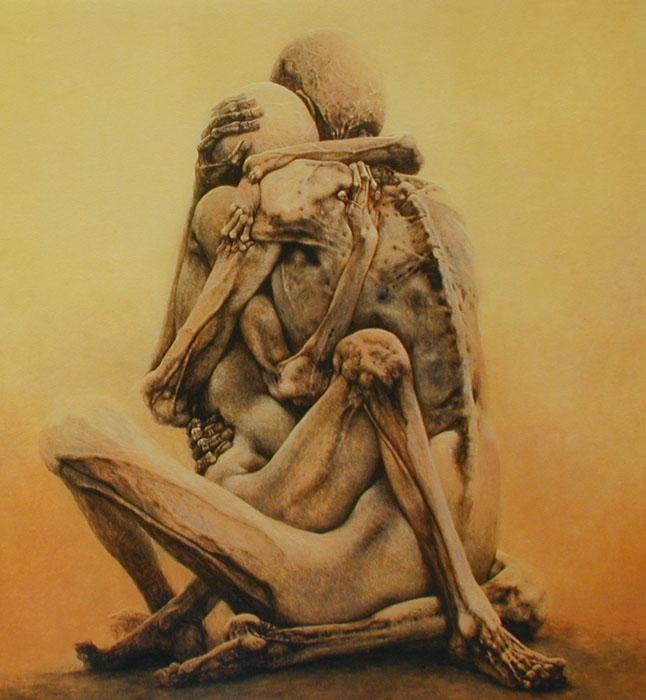
The Art of Zdzisław Beksiński: “Photographing Dreams”


Polish artist Beksinski(1929-2005) created abstract and surreal art in a variety of media, but he’s best known for the fantastic, sometimes disturbing paintings he produced in the 1970s and 1980s.  


Skeletons, corpses, sinister shadowy figures, dark landscapes, and looming cliffs and buildings abound. 

 
Speaking of these paintings in particular, Beksiński said, “I wish to paint in such a manner as if I were photographing dreams.”  In some cases, he seems to have succeeded.    


Beksiński moved on to digital art in the 1990s, and was murdered in 2005.  There are a few online galleries of his work here and here.


Saturday, August 27, 2011

The 2nd Fontana Book of Great Ghost Stories


My copy of the second Fontana collection of ghost stories arrived from an Amazon Marketplace seller with a mysterious black sticky spot on the back cover, in which were lovingly nestled several long, coarse hairs.  It was one of the more disgusting things I’ve found on a used book.

Robert Aickman’s introduction to the collection rambles and entertains as usual:  “Some people hope there are ghosts.  Some people hope there are not.  Most people, I suspect, manage to combine both of these aspirations, hoping and dreading at the same time.”

The opening story, Playing with Fire, is by none other than Sir Arthur Conan Doyle, and deals with a séance where the apparition is much more novel than the usual deceased relative.

Man-Size in Marble, by Edith Nesbit (best known for her early 1900s children’s books) conveys sadness and loss along with horror, as a young couple moves into a country cottage near a haunted church.

Robert Hichens’ How Love Came to Professor Guildea is frequently anthologized, and deserves to be.  Aickman dubs it “one of the best ghost stories ever written”.  It concerns a cold man of science and his downfall as an intangible thing creeps into his life and his home, a thing which is first heard via Guildea’s parrot imitating it:

“The voice was sickly and disagreeable, a cooing, and at the same time, querulous voice… a loathsome voice”.
 
While the owner of the voice only wants to love Guildea, the professor will have none of it.

The Demon Lover, by Elizabeth Bowen, is a short, tautly constructed piece dealing with the return of a woman’s former lover, thought lost in war.

A.V. Laider, by writer and caricaturist Sir Max Beerbohm, involves palmistry.  It has one sharp scene of macabre tension, but tends to ramble for the most part. 

Poe’s The Facts in the Case of M. Valdemar, with its “liquid mass of…loathsome putridity” (maybe that’s what was on the back cover of this volume) seems to have appeared in innumerable anthologies.

As much as I enjoy Lord Dunsany, the science fiction Our Distant Cousins (one of his Jorkens tales) is neither a ghost story nor great.  Aickman calls it a “superb allegory” in his introduction, but I can’t agree.

Aickman’s contribution, The Inner Room, is centered on a large and gloomy dollhouse and its inhabitants.  I think it’s one of his better stories; it showcases his talent for producing unsettling work that sticks with the reader due to ambiguity and sheer strangeness.

The cover illustration for this second volume of The Fontana Book of Great Ghost Stories is taken from a scene in Perceval Landon’s Thurnley Abbey –it portrays a mustached gent who at first glance I mistook for Hitler, crouching in fear as an apparition glides past.  This tale is effective and has the most tangible ghost of any in the collection.

Nightmare Jack, by John Metcalfe, is one of the lowlights here.  It’s a pulp magazine-ish story of stolen rubies and supernatural revenge, mostly told in dialect which is a little obnoxious to read. 

Ambrose Bierce’s The Damned Thing might be even more over-anthologized than Poe’s tale.  It’s always worth a read for those who enjoy Bierce’s bitter humor. 

Finally, Edith Wharton delivers with Afterward, which has a nice premise:

“That there’s a ghost, but nobody knows it’s a ghost?”
“Well – not till afterward, at any rate.”
“Till afterward?”
“Not till long afterward.”

For me, this second Fontana collection wasn’t as enjoyable as the first.  I’d read many of the stories elsewhere, and there were a few less than stellar selections.  Still, it does contain some excellent tales of terror.