James Lewicki (1917-1979) illustrated many magazine covers and books for LIFE and others, mostly in the 50’s and 60’s.
I encountered him as a small child reading the
The Life Treasury Of American Folklore
(1961).
The
Treasury stemmed from a series in LIFE Magazine, “The Folklore of America”, conceived and illustrated by Lewicki, which appeared in 1959-1960.
From the first full-page illustration of the “Sea of Darkness”, with gigantic sea monsters and blood-red waves, I was hooked.
 |
| The Sea of Darkness |
Some of the other illustrations were nice too…
 |
| A well-endowed mermaid lures Pascagoula Indians away from Jesus |
…but I was fascinated by the lurid, scary images Lewicki produced. Many of the people (and animals) seemed to be crazed and bloodthirsty, with staring eyes and overly-red mouths. Even many of the illustrations for non-spooky tales were themselves spooky.
 |
| The (Zombie?) Angel of Hadley |
The images burned into my brain, and for a while there were some pages I had to skip past, but I kept going back to the Treasury again and again. I recently flipped through the book 20-some years later, and there they were. They’d been lurking there all those years…
 |
| Bras Coupé |
 |
| Sedna's amputated fingers become marine mammals |
 |
| Ghost Pirates of Manhattan |
 |
| Loup-Garou Attack! |
The one illustration that really gave me the willies was the witch woman on pages 172-173, spinning off her skin. Good story, too: “As he watched, she spun her entire skin off her body as easy as the shucks off an ear of corn. When it was all off, she was revealed as an enormous, tawny-yellow cat. She took the skin and chucked it under the bed. “Lay there, skin,” she told it, “with that fool husband of mine snoring in the bed until I come back. I’m goin to have me some fun.””
 |
| The Witch Woman |
Someone else, probably scarred for life by these images like me, even went about creating a life-size
model of the witch woman.
The
Treasury itself has a wide range of stories from 1492 to World War II, including a number of unusual ones.
But, needless to say, the illustrations were the most memorable part for me.


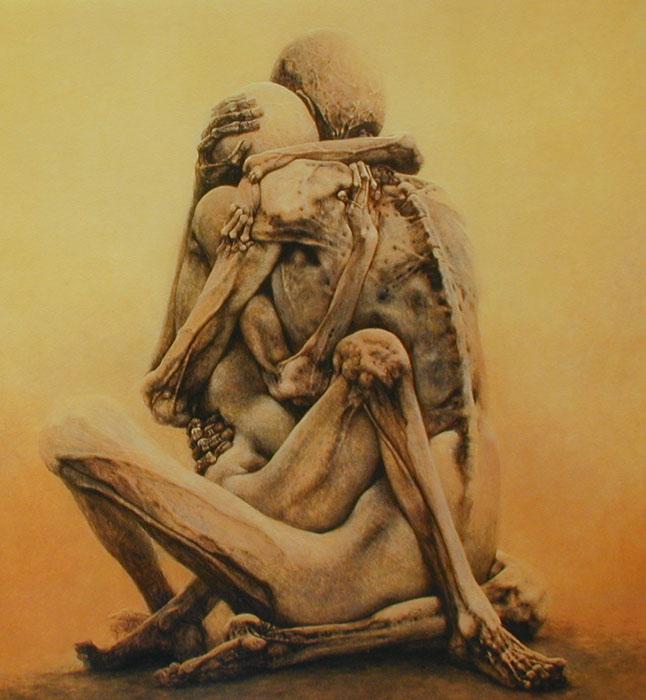
 (1929-2005) created abstract and surreal art in a variety of media, but he’s best known for the fantastic, sometimes disturbing paintings he produced in the 1970s and 1980s.


 (1961).


