Monday, March 28, 2011

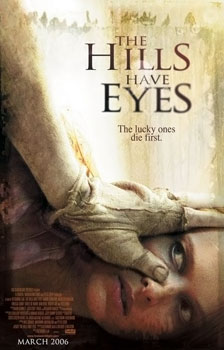
The Hills Have Eyes (2006): Haiku on Torture Porn

I watched The Hills Have Eyes, Alexandre Aja's remake of Wes Craven's 1977 fillm, while feverish.  This may have increased my distaste for it.  I don't have time for a full reflection on the value of gore-fests except to say that without plot, humor, or character they don't charm me.  Instead, I'll express my sentiments on The Hills Have Eyeswith a few haiku (well, maybe not haiku by traditional definitions, but they do follow the 5-7-5 structure, anyway).

Baby at gunpoint
See man burned alive, so gross
Pickaxe in a face

Lesson learned from film
Mutants are always evil
Let’s fear the deformed

Story: ten percent
Violence and gore: the rest
Redeeming features?  

Thursday, March 10, 2011

The Beyond: Fulci's Masterpiece?


After seeing Zombie and enjoying it for what it was, I was motivated to see The Beyond (1981) by various comments on the Internet Movie Database and other sites describing it as Lucio Fulci’s masterpiece, or at least one of his best.  Of course, other comments from Fulci fans charitably referenced the “slightly incoherent plot” and stated that the acting is “what you’d expect”, so I knew what I was getting in to.


Louisiana, 1927:  Instead of Randy Newman or any mention of flooding, we get a sepia-toned flashback with stern men bursting into a hotel to lynch a demented painter, Schweick.  First they tongue-lash him (“you ungodly warlock!”), then they lash him with a chain, nail him to a wall, and spatter him with bubbling lye, all in Fulci’s blood-spurting, flesh-rending detail. 

One hopes for a Lovecraftian slant, especially when the Book of Eibon comes into play, but it turns out that instead of a portal to the Great Old Ones, the hotel is built over one of the seven doors of Hell.

The scene switches to the present day (1981), as Liza (Catriona MacColl, who appeared in other Fulci films) inherits the rundown hotel.  Liza meets the caretakers, creepy Martha (Veronica Lazar) and her slow-witted son Arthur (Gianpaolo Saccarola), the sympathetic Dr. McCabe (David Warbeck), and the original Joe the Plumber (Giovanni De Nava), who quickly meets an eye-gouging fate (a Fulci trademark) in the basement which is somehow pronounced an “accident”.

In one of the more memorable scenes, Liza runs across the blind Emily (Cinzia Monreale) and her German shepherd, standing on an eerily deserted Lake Pontchartrain bridge.  “I’ve been waiting for you,” says Emily, so Liza takes them in, no questions asked.  Was Fulci going for the surreal or just too lazy to craft a plot that made sense?

Assuming the former makes the viewing experience more pleasant, since the plot is slightly more than incoherent.  It’s also fairly uninteresting.  If the premise is a hotel built atop a gateway to Hell, one really wants to see all Hell breaking loose at some point; but this is not a haunted hotel movie of the caliber of The Shining.  Fulci does try, with a spiked skull, ripped-off ear, torn throat, and exploding foreheads.  There’s an inventive bit in a bathtub, and at one point inexplicable tarantulas manifest to eat a man; only a few are live, and the ones in the background are models which are waggled unconvincingly back and forth.  The “Do Not Entry” sign in one scene is a classic.   
The acting is in fact what you’d expect, but there are some enjoyable lines:

“I’ve lived in New York all my life, and if there’s one thing I’ve learned not to believe in, it’s ghosts.”

“I’m a doctor and I want to accept the rational explanations!” 

“Somehow the basement’s flooded” (not entirely surprising in south Louisiana).

Overall, The Beyond just isn’t cohesive enough to be engaging.  I found Zombie to be much more interesting.
Monday, December 27, 2010

"Once the Lurking Lust is Loosed-": Robert Bloch's "The Night of the Ripper"


Robert Bloch had a writing career that spanned sixty years, during which he wrote about Jack the Ripper four times.  “Yours Truly, Jack the Ripper”, published in Weird Tales in 1943, presented the idea of the Ripper as an immortal making human sacrifices to stay that way.  He revisited the Ripper in “A Toy for Juliette” and the Star Trek episode “Wolf in the Fold”.  His most comprehensive look at the Whitechapel serial killer was in his 1984 novel The Night of the Ripper.     

The Night of the Ripper is replete with well-researched Ripper facts and historical detail: unusual slang (“buors” are prostitutes, “suckcribs” are beer halls), Victorian London locations and personalities involved in the case and, of course, gruesome descriptions of the bodies of the murder victims.

The background makes for entertaining reading, but the story itself is formulaic.  A wooden American doctor, Mark Robinson, joins forces with the dyspeptic Inspector Abberline to stop the fiend, while a nurse, Eva Sloane, provides the requisite love interest.  Characterization is weak and there are too many characters who are only introduced as potential Rippers.  Bloch feels the need to throw in cameos by Oscar Wilde, Arthur Conan Doyle, George Bernard Shaw, and John Merrick, to no discernible purpose.  When Bloch reveals the real Ripper, it’s possibly the least interesting choice of all the suspects.

The Night of the Ripper is a quick read and might be worthwhile for Bloch’s detailed account of the setting and the crimes, but as a novel it feels hastily constructed and superficial.  The fact that at some points it seems virtually any character could be the Ripper, and a few ruminations on the beast within (“conceal it though we may, the beast is always there, waiting to escape”) suggest the deeper study of psychological aberration Bloch might have undertaken.       

Sunday, December 19, 2010

"Be Prepared to Take the Good with the Evil...": The Kingdom (Riget) 1994-1995


Take a blender.  Add a distillation of hospital dramas.  Dump in a liberal helping of Twin Peaks, but enhance it with an extra dose of quirky humor.  Pour directly from a bottle of spirits (clamp the lid down quickly so they don’t escape).  Blend well, and you might get a rough approximation of The Kingdom (Riget), Lars von Trier’s eight-episode miniseries for Danish television.  However, The Kingdom is a unique concoction, hard to describe or replicate (although Stephen King adapted The Kingdom for American television as Kingdom Hospital,  which I haven’t seen but apparently stayed fairly true to the original).

Centered on Copenhagen's Rigshospitalet, the fictional Kingdom is a sepia-toned labyrinth full of ghosts and demons.  Built, according to the introduction, on the ancient “bleaching grounds”, it is stocked with ghostly ambulances, spirits crying in the elevator shafts, and the menacing shade of Udo Kier.

Like any good hospital drama, The Kingdom has an ensemble cast of patients, doctors, and support staff – they are just a little quirkier than most.  The Swedish chief of neurosurgery (Ernst-Hugo Järegård) hates his Danish coworkers, frequently shouting his catchphrase “Danish scum!”  His arch-rival, Jørgen (Søren Pilmark), works the system from his lair in the basement, and is not above a little blackmail to get his way.  The medium Mrs. Drusse (Kirsten Rolffes) keeps finding ways to get herself admitted to commune with the unquiet dead.  Dr. Bondo (Baard Owe) lusts after a patient’s liver tumor, while Dr. Petersen (Birgette Raaberg) experiences an unusual pregnancy.  Two dishwashers with Down Syndrome (Vita Jensen and Morten Leffers) make cryptic comments on the supernatural goings-on.  Lurking behind them all are the ghost girl Mary (Annevig Ebbe) and the ominous Age Krüger (Udo Kier).  Despite the short duration of the series, viewers get to know them all through a variety of bizarre subplots, and the acting and script make even the smallest role engaging.

The first series has its share of chills, but is also very funny.  The final episode ends with an attempted exorcism and a difficult childbirth; in both, horror and humor combine.  The second series is weaker, focusing more on the quirky humor of the characters and less on the horror.  Like the first season, there’s a cliffhanger ending, but sadly, a planned third season never came to fruition since several of the major actors died.

With The Kingdom, Lars von Trier presents a unique series, unclassifiable and highly entertaining. 


Friday, November 26, 2010

Night Watch (2004): The Terror of Spastic Director Syndrome


The establishing prologue for Night Watch (Nochnoy dozor in the original Russian) is not encouraging – two fantasy armies are doing battle, but they’re slightly cheesy, and you keep expecting to see Terry Gilliam prancing behind them banging coconut shells together.  The prologue is like those in many fantasy novels, easily skipped to get to the good stuff.  It’s a tedious way to set up the eternal contest between the supernatural “Others”, Light and Dark, each monitoring the opposing side to look for violators of their ages-old truce (the monitors are the Night Watch and Day Watch).

The film follows precog Anton (Konstantin Khabenskiy), a member of the Night Watch tasked with policing the Dark Others.  He’s a refreshingly shabby protagonist, a staggering, vagabond vampire hunter.  His Night Watch teammates include a few shapeshifters who never actually shape-shift, and Olga the were-owl (Galina Tyunina), who has a well-filmed, messy transformation scene and then seems to have nothing to do for the rest of the film.  The Night Watch members echo the Ghostbusters, with their jumpsuits and their bright yellow truck with flaming tailpipes, whizzing through the city streets to supernatural incidents.

There is a plot, but it is told incoherently, as if the director cut out half the footage at random.  The end result is loud, garish, confused, and somewhat annoying, with strange camera angles, quick jump cuts, and hardly a whisker of character development.  There’s something about the “Vortex of Damnation” and a cursed virgin, who appears to herald the final battle between Light and Dark, and a great Other who will choose sides and determine the outcome. 

The film and its sequel Day watch (2006) were based on a series of novels by Sergey Lukyanenko.  Perhaps if you’ve read the novels you can fill in the blanks in the movie version of Night Watch, but otherwise the events are made barely comprehensible by the spastic, jumpy direction.  The special effects, impressive for the overall budget of about 4.2 million, and sometimes inventive (wheeling clouds of ravens and a handy spine-sword), are the only real reason to see Night Watch

Saturday, November 6, 2010

Naked SCUBA! Zombie vs. Shark! Splinter-in-eyeball! It's Lucio Fulci's "Zombie"


Hot on the shambling heels of Dawn of the Dead (1978) came Lucio Fulci in 1979 with the imaginatively titled Zombie (sometimes titled Zombie 2 to confuse European viewers into thinking they were seeing the sequel to Romero’s film, which was titled Zombie in European releases). 

An abandoned boat (or is it?) drifts into New York Harbor.  It belongs to the vanished father of Ann (Tisa Farrow, Mia’s sister).  A note (“due to my morbid curiosity, I have managed to contract a strange disease”) points to the Caribbean.  Soon, Ann is on her way, joined by reporter Peter (Ian McCulloch, who went on to star in a different role in 1980’s Zombie Holocaust, a film which is unrelated to Zombie other than being filmed on the same sets, and alternately titled Zombie 3, apparently to confuse viewers even more).

The two convince boat bums Brian and Susan (Al Cliver and Auretta Gay) to take them to the supposedly cursed island of Matul, the home of Dr. Menard (Richard Johnson).  A zombie outbreak is underway, with no explanation for the cause other than some mumbling about voodoo. 

The highlight of Zombie occurs before the protagonists reach the island, as Susan goes naked SCUBA diving and is witness to a zombie eating a shark.   


It’s difficult to top that.  Fulci tries to do so with gore, giving up on the scanty plot for face-eating, arm-rending, flesh-ripping, splinter-in-eyeball mayhem.  In general, the special effects are realistically stomach-turning.  Gallons of blood are spilled, bright 70’s movie blood like tomato sauce (maybe it was tomato sauce?).

It’s surprising more zombie films aren’t set in the Caribbean, where, after all, zombies originated.  Zombie has pretty island scenery and brightly-colored villages where the zombies roam, and the soundtrack includes both cheerful island music and voodoo drums.  The film even includes a sort of tropical recreation of the cemetery awakening scene from The Plague of the Zombies and many others.

Although more gross than frightening, and not the most intelligent zombie film ever made, Zombie is undeniably entertaining and well worth a look.

Sunday, October 31, 2010