Saturday, November 12, 2011

Them: Best of the Giant Bug Movies


A shell-shocked little girl wandering through the New Mexico desert.  A mangled, deserted travel trailer.  An eerie piping from the desert wastes (“must have been the wind… it’s pretty freakish in these parts”).  A devastated general store in the midst of a sandstorm, the electric light bobbing wildly in the wind.  So begins the classic 1950s monster movie Them!, one of the best of the genre and certainly the best of the giant insect sub-genre.

The film starts out slow and sinister, as grizzled police Sergeant Peterson (James Whitmore) and fresh-faced FBI agent Robert Graham (James Arness) try to solve a string of disappearances and murders.  The lonely desert, with tumbleweeds, blowing sand, and howling wind, is used to great effect.  Soon, the doctors Medford, a father and daughter team of myrmecologists from the Department of Agriculture join the team, having identified a mysterious footprint as that of an oversized ant.  As the senior Dr. Medford, the great character actor Edmund Gwenn (who was in his late seventies when the movie was shot) injects a great deal of energy and humor to the film.  As his daughter, Joan Weldon gives a rather bland performance, perhaps aided by the fact that no romance really develops – it’s all about the ants.  Still, most of the acting is quite decent.     

The special effects, using enormous ant puppets, are surprisingly effective, and the first appearance of a giant ant, looming monstrously over a sand dune, is thrilling.  Much of the film is action-packed, with an arsenal of machine guns, flamethrowers, bazookas, and grenade launchers being deployed to combat the red (ant) menace.  Soldiers descend into creepy, dark ant nests in scenes reminiscent of the Alien films.  The pacing slows a little too much in the middle, but picks up again as the ants begin to spread across the country.  The finale is tense, claustrophobic, and, naturally, chock full of ants.      

It turns out the ants have mutated as a result of radiation from the first atomic bomb test.  As Dr. Medford gravely states, “When man entered the atomic age, he opened the door into a new world.”  Nuclear-age warning, communist allegory, or simply a good science fiction horror story, Them! is a must see.

Saturday, September 10, 2011

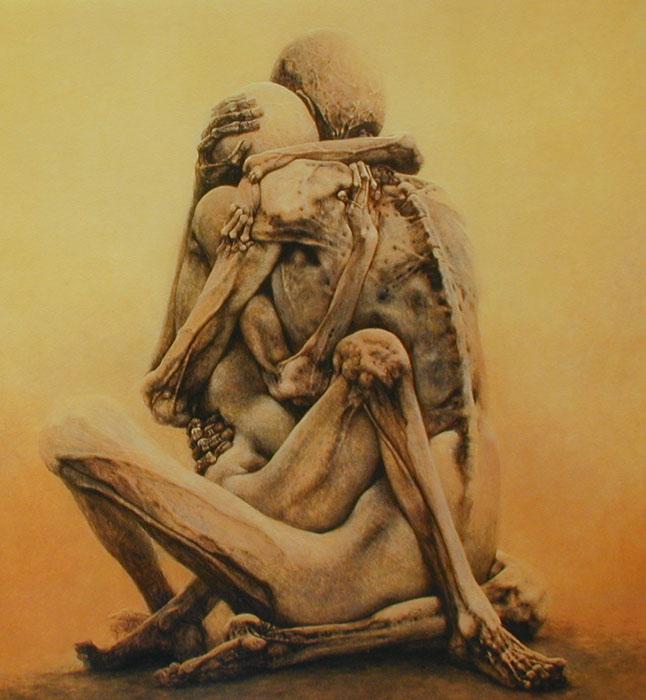
The Art of Zdzisław Beksiński: “Photographing Dreams”


Polish artist Beksinski(1929-2005) created abstract and surreal art in a variety of media, but he’s best known for the fantastic, sometimes disturbing paintings he produced in the 1970s and 1980s.  


Skeletons, corpses, sinister shadowy figures, dark landscapes, and looming cliffs and buildings abound. 

 
Speaking of these paintings in particular, Beksiński said, “I wish to paint in such a manner as if I were photographing dreams.”  In some cases, he seems to have succeeded.    


Beksiński moved on to digital art in the 1990s, and was murdered in 2005.  There are a few online galleries of his work here and here.


Saturday, August 27, 2011

The 2nd Fontana Book of Great Ghost Stories


My copy of the second Fontana collection of ghost stories arrived from an Amazon Marketplace seller with a mysterious black sticky spot on the back cover, in which were lovingly nestled several long, coarse hairs.  It was one of the more disgusting things I’ve found on a used book.

Robert Aickman’s introduction to the collection rambles and entertains as usual:  “Some people hope there are ghosts.  Some people hope there are not.  Most people, I suspect, manage to combine both of these aspirations, hoping and dreading at the same time.”

The opening story, Playing with Fire, is by none other than Sir Arthur Conan Doyle, and deals with a séance where the apparition is much more novel than the usual deceased relative.

Man-Size in Marble, by Edith Nesbit (best known for her early 1900s children’s books) conveys sadness and loss along with horror, as a young couple moves into a country cottage near a haunted church.

Robert Hichens’ How Love Came to Professor Guildea is frequently anthologized, and deserves to be.  Aickman dubs it “one of the best ghost stories ever written”.  It concerns a cold man of science and his downfall as an intangible thing creeps into his life and his home, a thing which is first heard via Guildea’s parrot imitating it:

“The voice was sickly and disagreeable, a cooing, and at the same time, querulous voice… a loathsome voice”.
 
While the owner of the voice only wants to love Guildea, the professor will have none of it.

The Demon Lover, by Elizabeth Bowen, is a short, tautly constructed piece dealing with the return of a woman’s former lover, thought lost in war.

A.V. Laider, by writer and caricaturist Sir Max Beerbohm, involves palmistry.  It has one sharp scene of macabre tension, but tends to ramble for the most part. 

Poe’s The Facts in the Case of M. Valdemar, with its “liquid mass of…loathsome putridity” (maybe that’s what was on the back cover of this volume) seems to have appeared in innumerable anthologies.

As much as I enjoy Lord Dunsany, the science fiction Our Distant Cousins (one of his Jorkens tales) is neither a ghost story nor great.  Aickman calls it a “superb allegory” in his introduction, but I can’t agree.

Aickman’s contribution, The Inner Room, is centered on a large and gloomy dollhouse and its inhabitants.  I think it’s one of his better stories; it showcases his talent for producing unsettling work that sticks with the reader due to ambiguity and sheer strangeness.

The cover illustration for this second volume of The Fontana Book of Great Ghost Stories is taken from a scene in Perceval Landon’s Thurnley Abbey –it portrays a mustached gent who at first glance I mistook for Hitler, crouching in fear as an apparition glides past.  This tale is effective and has the most tangible ghost of any in the collection.

Nightmare Jack, by John Metcalfe, is one of the lowlights here.  It’s a pulp magazine-ish story of stolen rubies and supernatural revenge, mostly told in dialect which is a little obnoxious to read. 

Ambrose Bierce’s The Damned Thing might be even more over-anthologized than Poe’s tale.  It’s always worth a read for those who enjoy Bierce’s bitter humor. 

Finally, Edith Wharton delivers with Afterward, which has a nice premise:

“That there’s a ghost, but nobody knows it’s a ghost?”
“Well – not till afterward, at any rate.”
“Till afterward?”
“Not till long afterward.”

For me, this second Fontana collection wasn’t as enjoyable as the first.  I’d read many of the stories elsewhere, and there were a few less than stellar selections.  Still, it does contain some excellent tales of terror. 

Sunday, August 21, 2011

Fevre Dream: George R.R. Martin's Vampire Novel

George R.R. Martin's Fevre Dream: Signature EditionAs previously mentioned I like what I’ve read of George R.R. Martin, for the most part.  I was excited to add Fevre Dream to the list.

First published in 1982 and widely available again since the success of A Song of Ice and Fire, Fevre Dreamcombines vampires and 1850’s Mississippi River paddlewheelers.  Gruff riverboat captain Abner Marsh is given an offer he can’t refuse:  the cash to build and captain a massive new sidewheeler, which he christens Fevre Dream.  The only downside is his investor and co-captain, the mysteriously pale and nocturnal Joshua York.  York makes odd demands and invites a host of similarly-nocturnal friends on board the ship, testing Marsh’s patience and provoking his curiosity.  As Marsh digs deeper, he begins to realize that as sinister as York may   be, there are even more sinister forces stirring on the Lower Mississippi.  

Fevre Dream Martin did his historical research for Fevre Dream’s Mississippi River setting (or at least read Life on the Mississippi).  The rivers, the towns, and the steamships are given enough detail to come alive and make the book something of a historical novel.  Unfortunately, much of the story stays in sluggish, shallow waters.  The vampires aren’t very interesting, and the stakes for defeating them aren’t very high.  The novel progresses slowly yet jerkily, with a long and unnecessary digression into York’s back story and a thirteen-year timeout between acts.  There are a few nice action-packed moments, but tension isn’t maintained and frights are few to none; the whole thing just kind of drifts downstream.     

Fevre Dream isn’t terrible by any means, but it is quite lackluster compared to most of what I’ve read from Martin.  I found myself wishing that the vampires would just go away so Captain Marsh could get on with his riverboating adventures, and thinking that the novel would have been just as good, or better, with natural villains instead of supernatural ones.      

Wednesday, August 10, 2011

James Lewicki: He made American Folklore Creepy

James Lewicki (1917-1979) illustrated many magazine covers and books for LIFE and others, mostly in the 50’s and 60’s.  I encountered him as a small child reading the The Life Treasury Of American Folklore (1961).  The Treasury stemmed from a series in LIFE Magazine, “The Folklore of America”, conceived and illustrated by Lewicki, which appeared in 1959-1960.

From the first full-page illustration of the “Sea of Darkness”, with gigantic sea monsters and blood-red waves, I was hooked.
The Sea of Darkness
 Some of the other illustrations were nice too…
A well-endowed mermaid lures Pascagoula Indians away from Jesus
 
…but I was fascinated by the lurid, scary images Lewicki produced.  Many of the people (and animals) seemed to be crazed and bloodthirsty, with staring eyes and overly-red mouths.  Even many of the illustrations for non-spooky tales were themselves spooky. 
The (Zombie?) Angel of Hadley
The images burned into my brain, and for a while there were some pages I had to skip past, but I kept going back to the Treasury again and again.  I recently flipped through the book 20-some years later, and there they were.  They’d been lurking there all those years…   
Bras Coupé
  
Sedna's amputated fingers become marine mammals
Ghost Pirates of Manhattan
  
Loup-Garou Attack!
The one illustration that really gave me the willies was the witch woman on pages 172-173, spinning off her skin.  Good story, too:  “As he watched, she spun her entire skin off her body as easy as the shucks off an ear of corn.  When it was all off, she was revealed as an enormous, tawny-yellow cat.  She took the skin and chucked it under the bed.  “Lay there, skin,” she told it, “with that fool husband of mine snoring in the bed until I come back.  I’m goin to have me some fun.””
The Witch Woman
Someone else, probably scarred for life by these images like me, even went about creating a life-size model of the witch woman.

The Treasury itself has a wide range of stories from 1492 to World War II, including a number of unusual ones.  But, needless to say, the illustrations were the most memorable part for me.

Tuesday, August 2, 2011

The Lurking Horror: Infocom's Lovecraftian Text Adventure Game

Via guetech.org
Infocom produced classic text adventure games, starting with Zork in 1980, and running the gamut from detective stories (Deadline) to pirate romance (Plundered Hearts); some games (e.g. Trinity, A Mind Forever Voyaging) were strikingly unique and unclassifiable.  Back in 1987, strange aeons ago in computer game time, Infocom released The Lurking Horror, an H.P. Lovecraft-inspired text adventure game. Written by Infocom cofounder Dave Lebling, The Lurking Horror was the very first Lovecraftian computer game. 

There aren’t any overt Cthulhu Mythos references in The Lurking Horror (although the name “Lovecraft” is dropped), but the style is there.  The story takes place at G.U.E. Tech, an MIT clone down to the steam tunnels (an early site of urban exploration).  You take the role of a student trying to finish a term paper for “The Classics in the Modern Idiom” during a blizzard (“You wonder, yet again, why a technical school requires you to endure this sort of stuff.”).  The campus is almost deserted and the file containing the paper has been corrupted by Department of Alchemy files which are bizarre, to say the least, including “woodcut illustrations which are queasily disturbing”.  They seem to reference sacrifices and summoning, and before you know it, you have a dream about an ichor-dripping thing with palps.  As you traverse the deserted buildings, the storm worsens and you begin to realize that, well, a lurking horror (as opposed to a  Lurking Fear) lurks on campus.

Most of Infocom’s games concentrated on puzzles, and some were quite difficult.  There are a number of these in The Lurking Horror, and, like the rest of the Infocom games, they’re made more difficult by the game’s limited vocabulary – players are forced to spend a lot of time trying to express themselves using words the game understands.  Lebling did a nice job evoking the dark, deserted, snowed-in campus – there aren’t a lot of horrific thrills, but mostly, playing the game will give you a cold, oppressive feeling. 

To make up for forcing you to use your imagination (and as copy protection), Infocom games tended to come with a lot of extras in the box; The Lurking Horror included a little rubber centipede-thing, among others.
Via guetech.org
 
 The Lurking Horror is now classed as abandonware.  If you really want to peer into computer gaming history and see a blue screen telling you “I don’t know the word “X” again and again as you figure out the commands, you can download it at Abandonia, or even play it online.
  

Monday, July 25, 2011

Joshua Hoffine's "Fears of Childhood"


I just discovered horror photographer Joshua Hoffinethanks to a random post on an imageboard of some of his "Fears of Childhood" series, including the one above (my favorite).  Striking, to say the least. 

 Hoffine, whose website is here, frequently uses friends and family, particularly his daughters, as models.  He also maintains a blog, which is very interesting for a behind-the-scenes look at how he goes about creating his horrific images.
Hoffine's photography has been featured in Famous Monsters of Filmland and Fangoria, among others.