Sunday, December 27, 2020

Horror Gaming Nostalgia: The Haunted PS1 Demo Disc


My time as a gamer essentially ended in the last century with the PlayStation 1.  Resident Evil was kind of a big deal.  Now, thanks to 90s nostalgia (and maybe relative ease of programming), indie game developers are bringing back that low-poly 3D aesthetic.

One example of this trend is the Haunted PS1 Demo Disc, a collection of 17 diverse demos in lovingly-crafted retro PS1 style, down to a jewel case mock up and a pseudo-commercial.


Some of the demos are non-spooky and forgettable.  Others are so blurry that they act as a “lost my glasses” simulator, although arguably not being able to see what’s going on enhances the horror.  

A common issue...

There are some standouts, though.  Heartworm, “a game about the memories we keep and the ones we wish we could forget” transports a Tomb Raider-ish character into an empty neighborhood full of mist and menace.  What exactly is that red glow in the side yard?  Filthbreed, while nothing novel concept-wise, is polished and harrowing as the protagonist navigates an infested house.  Much more novel is Sauna2000, which combines a sauna simulation and informal Finnish language tutorial with surreal horror and multiple endings.   

Sauna2000

Among the best is Ode to a Moon, which unexpectedly segues from detective procedural to hypnotic, shifting, psychedelic Lovecraftian geometry.  Nothing much describable happens in the Ode to a Moon demo, but that’s ok – it’s enough to sit back and soak up the atmosphere.

Ode to a Moon

I liked these demos not so much for the 90s flavor as for the imagination the developers put into them – out of the mainstream, there’s a sense of the unexpected, and you never know what might lurk around the next murky, blocky corner.           

Saturday, October 31, 2020

Happy Halloween!

Traditional Irish turnip Jack-o'-lantern, via Rannpháirtí anaithnid at English Wikipedia 

Wednesday, June 3, 2020

Clutter and Claustrophobia: The Weirdstone of Brisingamen

There is a special horror to being trapped underground in narrow passages. I was steered to Alan Garner’s The Weirdstone of Brisingamen by way of Robert MacFarlane’s Underland (which is a very interesting read). MacFarlane writes of, as a ten-year-old:

 “…reading the account… of two children escaping danger by descending the mining tunnels that riddle the sandstone outcrop of Alderley Edge in Cheshire. Deep inside the Edge, the embrace of the stone becomes so tight that it threatens to trap them… those passages took cold grip of my heart, emptied my lungs of air.”

Inspired by this and by MacFarlane’s accounts of his own underground explorations, I found a copy of the 1978 edition of Weirdstone (it was originally published in 1960). Coming a year after the success of the first Star Wars film, it looks like ACE tried to drum up sales with cover art depicting a Darth Vader knock-off in the foreground and an Obi-Wan imitator sneaking up behind him.


There are no far-away galaxies here, though. Garner uses as his inspiration a local legend of the Wizard of Alderley, and especially the geography of the area. The plot follows two rather featureless children, Colin and Susan, as they are sent to live with rustics in Cheshire while their parents go abroad. They are soon enmeshed in a supernatural struggle for the titular Weirdstone, allying with the wizard Cadellin and some dwarves against the evil Grimnir (who does not, in fact, have much in common with Darth Vader) and his army of orcs svarts.

This was Garner’s first novel, and it is not polished. The influence of Tolkien shows strongly. Garner uses a hodge-podge of fantastic names, from Durathror and Gaberlunzie to Ragnarok (used as a place-name). A host of fantastic beings come and go, not always essential to the plot (which essentially involves Colin and Susan being chased from place to place). It is altogether too cluttered.

Garner was a Cheshire native, and it’s the descriptions of real-world settings that provide the only real interest in the book, especially the vividly written, claustrophobia-triggering explorations into the abandoned copper mines of Alderley Edge:

“They lay full length, walls, floor and roof fitting them like a second skin. Their head were turned to one side, for in any other position the roof pressed their mouths into the sand and they could not breath. The only way to advance was to pull with the fingertips and push with the toes, since it was impossible to flex their legs at all, and any bending of the elbows threatened to jam the arms helplessly under the body.”

Although the fantasy may be generic, the descriptions of place are anything but.

Weirdstone apparently was well-received and stuck in the minds of many young readers. It was faintly reminiscent of Susan Cooper’s excellent The Dark is Rising series, with wicked ravens, threatened children, and ordinary villagers who are actually part of the evil forces. Cooper’s books, however, are much, much better.

You can see the mines of Alderley Edge, including some of the very places Garner wrote about, thanks to my new favorite YouTuber, Martin Zero, here and here.

Wednesday, May 1, 2019

Val Lewton's The Seventh Victim


Released in 1943, The Seventh Victim is not Val Lewton's best.  His previous films were directed by Jacques Tourneur, and now Mark Robson is at the helm, and something is missing.  Lewton’s work with Tourneur had a surreal quality which did not quite survive after RKO assigned Tourneur elsewhere.  Tourneur regretted the move, stating that his work with Lewton was a “perfect collaboration”.  Aside from The Body Snatcher, Lewton’s early work is superior to his later films.  Still, The Seventh Victim bears his distinct touch, enhanced by the uncredited final script draft he wrote for all his films.    


Schoolgirl Mary (Kim Hunter, in her first film role) learns that her only living relative, her beautiful and wealthy sister Jacqueline (Jean Brooks), is missing.  Mary travels to New York City to find out what happened.  Her inquiries lead her to Gregory Ward (Hugh Beaumont, better known as Beaver’s father), a helpful if rather slick gentleman who claims to be a paramour of the missing woman.

Several of Lewton’s regulars are present, including Tom Conway, who gives a nice performance as Dr. Louis Judd, a debonair but sinister psychiatrist with a pencil-thin mustache.  Conway had the same seedy role in The Cat People (1942) and was a player in I Walked with a Zombie (1943), Lewton’s best.  Judd leads Mary to her sister’s location, but after a brief wordless encounter, Jacqueline disappears again.  This and a hanging noose in a rented room lead to suspicions that Jacqueline is mentally disturbed.  Has she fallen victim to the loneliness and claustrophobia that can strike in the midst of a big city?  Or is there an even more sinister explanation?    

The Seventh Victim is slow getting started.  Something is missing – not just Mary’s sister, but something from the script.  Is it the usual Lewton charm of engaging bit characters and subplots?  There are some amiable Italian restaurant owners, a failed poet, and others, but they lack interest.  Or is it a general lack of menace and too much of the commonplace?  Most of the movie is bland and feels like filler.   

That said, there are redeeming qualities, as there always are in Lewton’s films.  While the indoor scenes are dull, outside it is rich in Lewton atmosphere, a shadowy, deserted city where it is always night and the few passersby are faceless men in hats and overcoats, unlikely to be of help.  Early on, a sinister late-night subway train is used to excellent effect.  A few scenes foreshadow later, better films: a slightly creepy shower scene long before Psycho, and a pre-Rosemary’s Baby use of a sinister cult of commonplace people. 

In the last fifteen minutes, The Seventh Victim becomes what it should have been throughout.  Jacqueline flees silently from shadowy pursuers through the dark streets, the quiet punctuated jarringly by a foraging dog, screeching brakes, and rowdy chorus members bursting from a theater.  Instead of blandness, the film ends with menace and sadness.  It’s a pleasant surprise, but it leaves the viewer wishing this atmosphere would permeate the entire film.

Tuesday, December 18, 2018

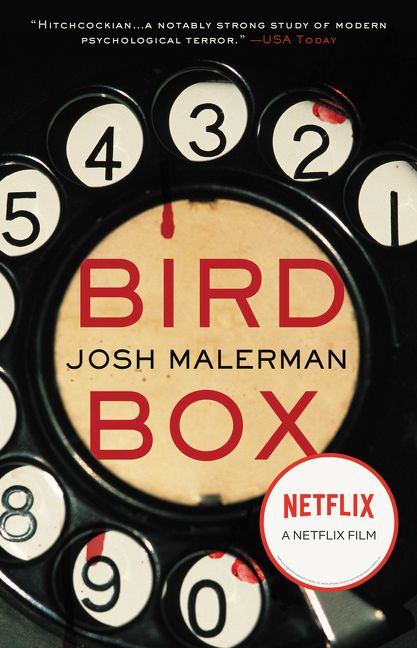
Bird Box: "You're mad!"


 Image result for bird box book
Josh Malerman’s short novel Bird Box was published in 2014.  Recently, it’s been adapted as a Netflix film with Sandra Bullock, to be released on December 21.  I was attracted to Bird Box by the premise – a mysterious something which cannot be seen without going mad has arrived on Earth, and the survivors must keep the curtains down or wear blindfolds if they go outside.

Wow, I thought, this must be a sort of cosmic Lovecraftian horror.  What a great idea, taking out the visuals and relying on the horror of scent, sound, and touch.  Imagine protagonists going out in their backyard blindfolded and creeping, terrified, cheek to jowl with Yog-Sothoth.  Imagine the chilling, mysterious descriptions of their other senses interpreting “a congeries of iridescent globes” - but how difficult a concept to execute.

Ay, there’s the rub.  Malerman often fails to live up to the challenge, providing an example of the familiar caveat for beginning writers:  ideas are the easy part, writing is the hard part.  Bird Box shows a distinct lack of imagination in terms of describing a world without sight.  For example, at one point, the protagonist’s dog is driven mad:

“It sounded like Victor had chewed through his own leg.” 

What does this sound like, exactly?  Maybe Victor just found a tasty rawhide chew.

Inadequate description aside, I found Malerman’s writing unenjoyable and sometimes irritating (the “tip” of the boat?).  The language is plain and simple, often delivered in text message-sized bits.  The characters are like the ones in lackluster horror movies who exist only to be picked off, with so little backstory or personality that it’s difficult to separate them into distinct individuals.  There’s Malorie (the protagonist), Tom (Malorie’s love interest, although Malerman tells us this but never shows us), Felix, Don, Jules, Cheryl, Olympia (the pregnant one), Victor (the dog), and, of course, Gary (“You’re mad!”).  Only “The Boy” and “The Girl”, children born since the apocalypse, inspire any feeling whatsoever.

There is something less than a skeleton of a story here – maybe the stapes or coccyx, the merest forepaw to suggest what might have been.  Bird Box focuses more on the claustrophobic horror of being trapped in a house with a bunch of other people than on what’s lurking outside.  Incidentally, it’s convenient that the house in which the characters shelter is provided with working phone lines and electricity for years after society has collapsed, not to mention a well in the backyard.  There is plenty of canned food available, but sadly no boards to nail over the windows (of course, blankets can be dramatically ripped down when drama is needed).

On the positive side, Malerman does resist the temptation to explain or reveal much about the crazy-inducing creatures which are roaming the world, leaving their true nature ambiguous.  The idea that whatever it is might not even have any malign purpose is an appealing one.

I really can’t imagine Bird Box converting to film very well.  After all, the whole point is the lack of sight.  Watching Sandra Bullock stumble around in a blindfold for two hours sounds vaguely amusing, but completely lacking in chills.  Like the novel, it seems unlikely to live up to the premise.

Wednesday, October 31, 2018